GW240908_082628

Computed from measured data · the sky behind it is our own, a stand-in (what this picture is drawn from)
Drawn from measured values
- Mass: 65 times the Sun's (LIGO, Virgo and KAGRA, GWTC-5.0)
- Distance: 10.1 billion light-years (LIGO, Virgo and KAGRA, GWTC-5.0)
- The shadow and the way the sky bends around it are worked out from its mass and spin with Einstein's general relativity
Chosen for the picture, not measured
- The sky behind it is our own Milky Way, from ESO's photograph, standing in for the real sky around this black hole. It is a part of the Milky Way's bright band (towards the galactic centre, in Sagittarius), not the direction this merger was seen in, which is known only roughly
- Nothing is known to orbit this black hole, so nothing is drawn around it
- Spin: about 0.71 of the most a black hole can spin, worked out by us from the two merging black holes' measured masses and their measured average spin (a published formula, Barausse and Rezzolla 2009); no spin is published for it
- The direction we see it from, and which part of the Milky Way lies behind it, are our choice; they are chosen so the bright band lies behind the hole
- The photograph is brightened and its brightest stars toned down, so the bent sky reads clearly; every star in it is the photograph's own
- Its size in the picture is not to scale: every black hole's picture is framed to the size of its own shadow
Drawn by gravityfinder’s own renderer from this black hole’s data. Sky photograph: ESO/S. Brunier (CC BY 4.0). How the pictures are made · Use our pictures
Sky photograph: ESO/S. Brunier (CC BY 4.0). The sky is bent by the black hole's computed gravity.
A black hole of about 65 solar masses, formed on 2024-09-08 when two black holes of roughly 40 and 28 solar masses spiralled together 10.1 billion light-years away. LIGO and Virgo felt the collision as ripples in spacetime.
The two black holes that merged were about 40 (30–52) and 28 (19–36) solar masses. The remnant is 65 (52–76) solar masses. Values in parentheses are the 90% credible ranges from LIGO, Virgo and KAGRA (GWTC).
Its event horizon, the edge past which nothing returns, spans about 192 km in radius. The waves we detected had been travelling for 10.1 billion years before they reached us.
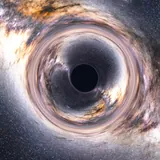 GW190916_200658Gravitational-wave source65.0 ☉
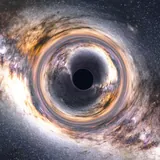 GW240919_061559Gravitational-wave source64.7 ☉
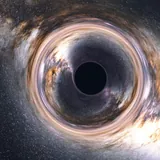 GW230922_020344Gravitational-wave source65.4 ☉
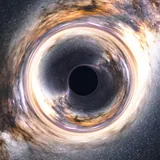 GW190727_060333Gravitational-wave source65.4 ☉
 GW240920_124024Gravitational-wave source65.6 ☉
 GW250118_170523Gravitational-wave source64.4 ☉
Sky photograph: ESO/S. Brunier (CC BY 4.0). In each picture the sky is bent by that black hole's computed gravity.