Large Magellanic Cloud
LMC
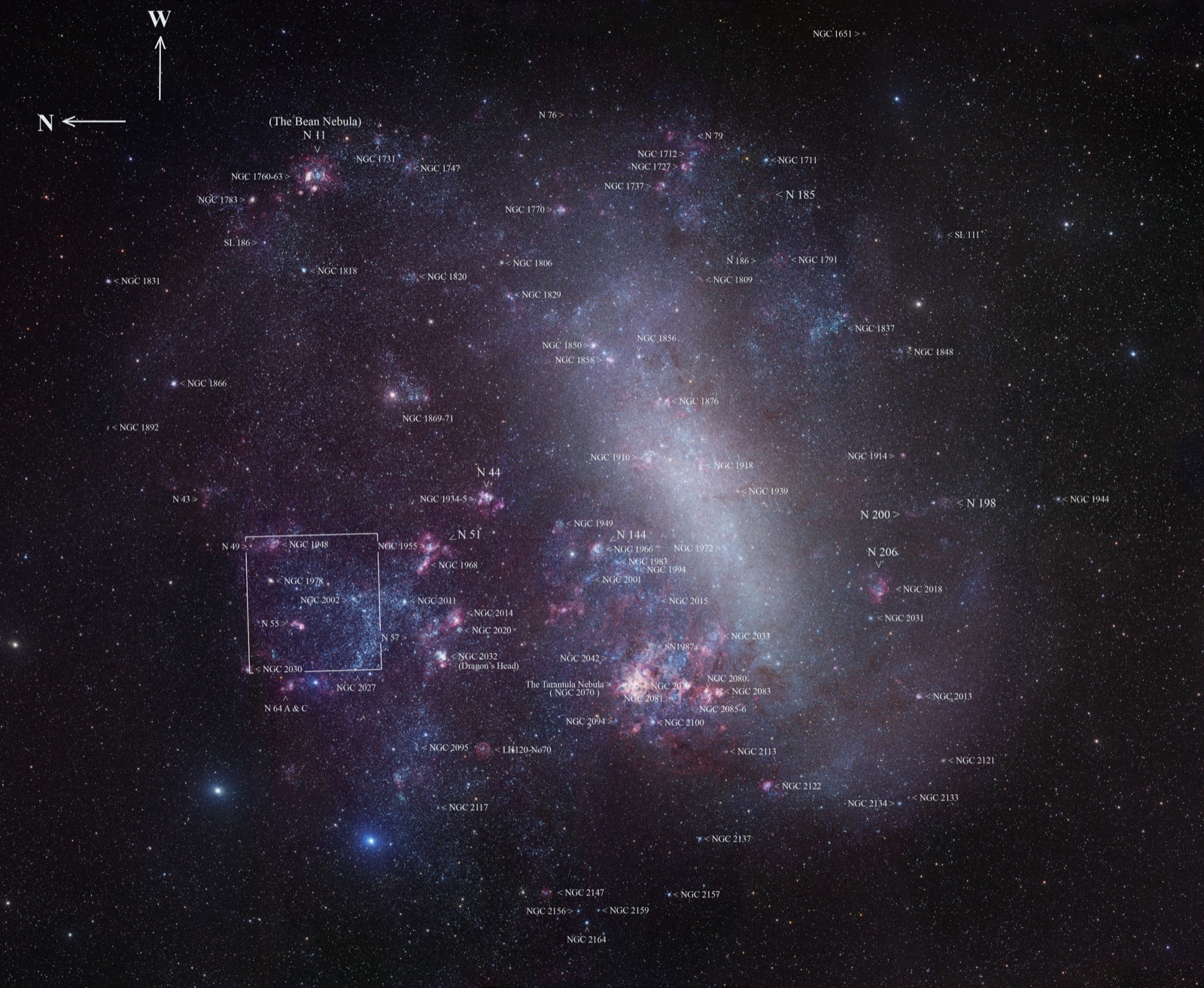
A satellite of the Milky Way and a naked-eye smudge of the southern sky, holding the Tarantula Nebula and the most massive stars known.
Large Magellanic Cloud is an irregular galaxy in the constellation Dorado about 163,000 ly from Earth. It spans roughly 32,000 ly, about 32% of our Milky Way's width. At magnitude 0.9 it is visible to the naked eye.
Irregular
type · SB(s)m
163,000 ly
from Earth · measured
32k ly
across
0.9
apparent magnitude
Because its light is 163,000 ly from home, you are seeing Large Magellanic Cloud as it looked roughly 163,000 years ago. The photons left before that much of history had passed, and are only now reaching us.
Black holes here
Notable stars here
R136a1Most massive star known→R136a2Among the most massive stars known→Melnick 42Among the most luminous supergiants known→VFTS 682A very massive star living almost alone→HD 269810Among the most luminous O-type stars, and a runaway→Melnick 34Most massive binary star known→S DoradusThe prototype luminous blue variable→WOH G64First star outside the Milky Way imaged in close-up→Sanduleak -69° 202Progenitor of Supernova 1987A→
Nearest galaxies
Small Magellanic CloudIrregular75,000 ly
apartMilky WayBarred spiral160,000 ly
apartAndromedaSpiral2.6 million ly
apartTriangulumSpiral2.8 million ly
apartSculptorStarburst11 million ly
apartCigarStarburst12 million ly
apart
Worlds in the same direction on the sky→apartMilky WayBarred spiral160,000 ly
apartAndromedaSpiral2.6 million ly
apartTriangulumSpiral2.8 million ly
apartSculptorStarburst11 million ly
apartCigarStarburst12 million ly
apart
Source: structural data (position, morphology, brightness, redshift) from OpenNGC (CC BY-SA). Distance from published measurements.