GW200220_124850
Gravitational-wave source · GWTC-3-confident
A black hole of about 64 solar masses, formed on 2020-02-20 when two black holes of roughly 39 and 28 solar masses spiralled together 13.0 billion light-years away. LIGO and Virgo felt the collision as ripples in spacetime.
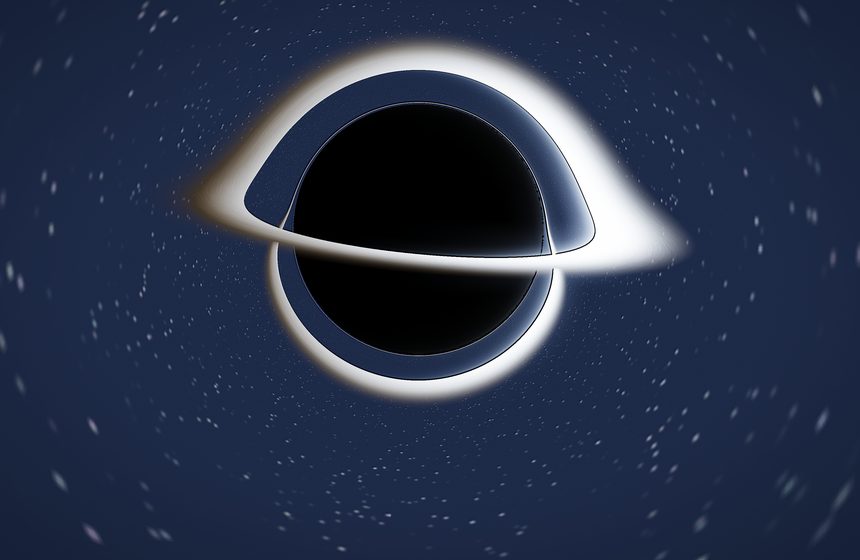 Computed render
64.0 ☉
mass (the Sun = 1)
189 km
event-horizon radius (computed)
13.0 billion ly
from Earth
39+28 ☉
the two that merged
The two black holes that merged were about 39 (30–53) and 28 (19–37) solar masses. The remnant is 64 (53–80) solar masses. Values in parentheses are the 90% credible ranges from LIGO, Virgo and KAGRA (GWTC).
Its event horizon, the edge past which nothing returns, spans about 189 km in radius. The waves we detected had been travelling for 13.0 billion years before they reached us.
Black holes of similar mass
GW240716_034900Gravitational-wave source63.9 ☉GW170823Gravitational-wave source63.9 ☉GW241002_030559Gravitational-wave source64.2 ☉GW250118_170523Gravitational-wave source64.4 ☉GW240919_061559Gravitational-wave source64.7 ☉GW240501_033534Gravitational-wave source63.1 ☉
Source: Gravitational-Wave Open Science Center (GWTC-3-confident), LIGO Virgo KAGRA. CC BY 4.0. See data & analysis for full sourcing.